

EU Circular Economy Act 2026 Set to Transform European Tyre Recycling Sector
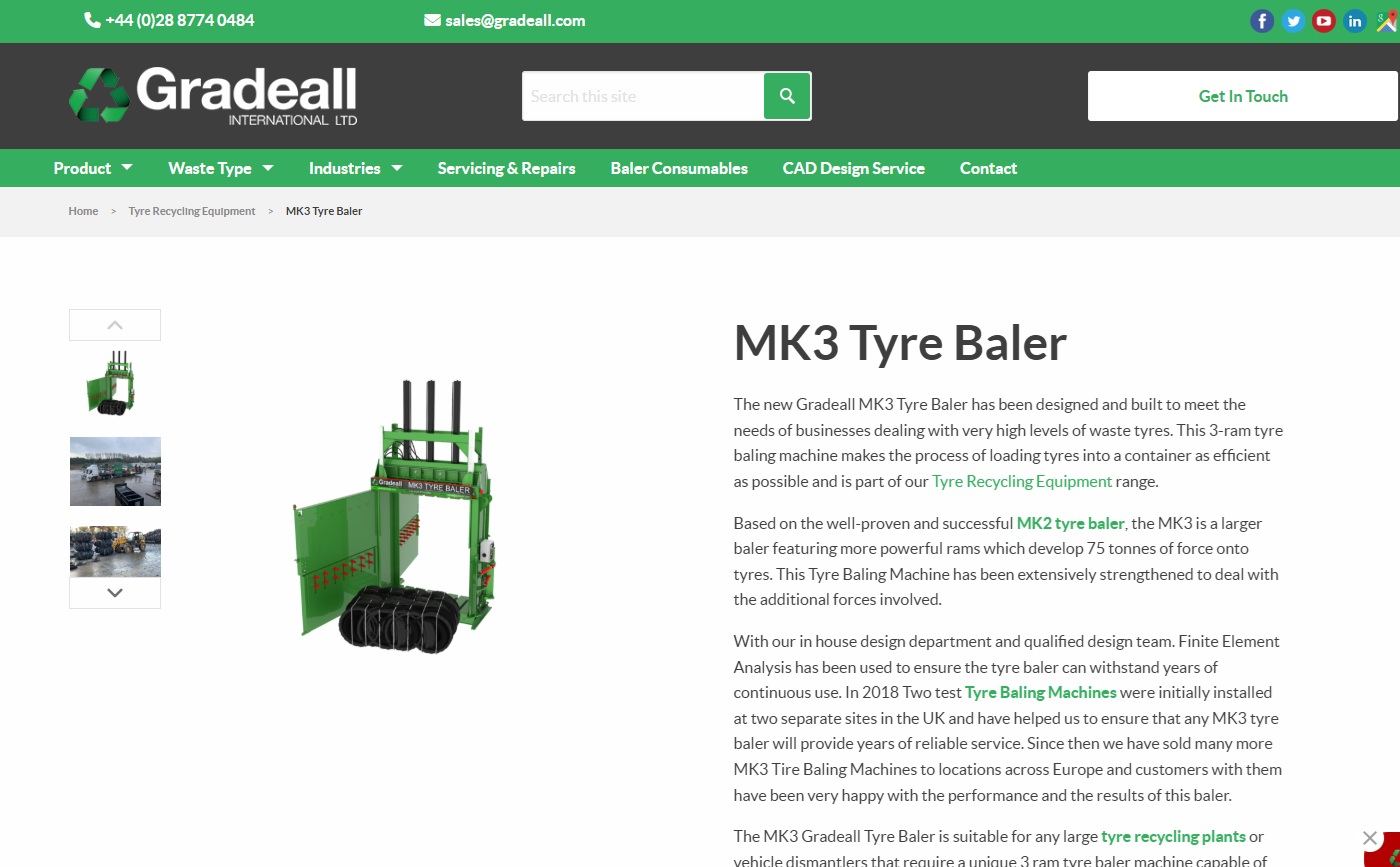
The new Gradeall MK3 Tyre Baler has been designed and built to meet the needs of businesses dealing with very high levels of waste tyres.
EU Circular Economy Act 2026 Set to Transform European Tyre Recycling Sector gradeall.com
EU Circular Economy Act 2026 Set to Transform European Tyre Recycling Sector
EU Circular Economy Act 2026 Set to Transform European Tyre Recycling
EU Economy Act 2026 Set to Transform European Tyre Recycling
European Commission proposals for harmonised End-of-Waste criteria and recycled content targets create significant opportunity for tyre processing investment
The Clean Industrial Deal published by the European Commission in 2025 places circularity at the heart of European industrial policy, promising to prioritise access to recycled materials, reduce dependencies on virgin resource imports, and strengthen industrial resilience against supply chain disruptions. The forthcoming Circular Economy Act aims to translate these strategic objectives into binding requirements that will reshape waste processing sectors including tyre recycling.
EURIC, the European Recycling Industries' Confederation, and ETRMA, the European Tyre and Rubber Manufacturers' Association, have jointly called for the development of EU-wide End-of-Waste criteria for rubber from end-of-life tyres. They argue that harmonised standards would strengthen the European recycling sector, enable recovered materials to flow more freely across the internal market, and support the investment in processing infrastructure that Europe needs to achieve its circular economy ambitions.
"The regulatory direction is clear - Europe wants materials recovered from waste streams including tyres to re-enter manufacturing supply chains rather than being exported or downcycled," says Conor Murphy of Gradeall International, a Northern Ireland-based tyre recycling equipment manufacturer. "Businesses investing in processing capacity now will be well positioned when these requirements come into force."
What Are End-of-Waste Criteria and Why Do They Matter
Currently, materials derived from end-of-life tyres retain their classification as waste even after extensive processing, creating regulatory barriers to their use in new products and limiting market development for recovered rubber materials. End-of-Waste criteria would establish clear conditions under which recovered rubber ceases to be classified as waste and can be traded freely as a secondary raw material.
This distinction matters significantly for commercial operations. Materials classified as waste face regulatory requirements around storage, transport, and handling that add cost and complexity to business operations. Waste shipments across borders require notification and consent procedures. Manufacturers using waste-classified materials in products face additional compliance burdens compared to using virgin materials or properly classified secondary raw materials.
Several EU member states have already established national End-of-Waste criteria for tyre-derived materials, recognising the need to support domestic recycling industries. Portugal, Spain, France, Italy, and Lithuania have all implemented national frameworks. However, the absence of harmonised EU-wide criteria creates complexity for processors operating across borders and fragments what should be an integrated European market for recovered rubber.
The Joint Research Centre, the European Commission's science and knowledge service, has identified rubber recycled from end-of-life tyres among the top three most suitable candidate streams for further EU-wide End-of-Waste criteria development. This technical assessment confirms that the tyre recycling sector is well-suited for harmonised European standards that would support market development.
Industry associations have expressed frustration at the pace of progress. Despite the Joint Research Centre's recommendations and widespread calls from the entire tyre value chain, development of harmonised criteria has stalled for more than three years. EURIC and ETRMA argue that when the value chain agrees on common standards, swift implementation should follow rather than extended bureaucratic delays.
For tyre recycling businesses, clear End-of-Waste criteria would simplify regulatory compliance, reduce administrative burden, open new markets for recovered materials, and provide certainty for investment planning. Processors would benefit from being able to supply secondary raw materials to manufacturers across Europe rather than managing complex waste shipment procedures.
Recycled Content Requirements on the Horizon
Beyond End-of-Waste criteria, the European recycling industry has called for binding recycled content targets that would guarantee demand for recovered materials and support investment in processing capacity. EURIC's manifesto proposes that products including tyres should be required to incorporate minimum percentages of recycled content, creating pull-through demand from manufacturers.
Major tyre manufacturers have already announced voluntary commitments to increase recycled content in their products, signalling industry readiness for such requirements. Michelin has set ambitious targets for sustainable materials, with recent announcements including new recycling facilities in the UK and Chile as part of ambitions to achieve 100% sustainable materials by 2050. Continental, Bridgestone, and other major manufacturers have announced similar sustainability commitments.
These voluntary initiatives could be reinforced and standardised by regulatory requirements under the Circular Economy Act. Mandatory recycled content would create level playing field conditions where all manufacturers face the same requirements, preventing sustainability leaders from being undercut by competitors using cheaper virgin materials.
The Ecodesign for Sustainable Products Regulation (ESPR), currently being implemented across the European Union, will establish circularity requirements for product categories including tyres. This regulation aims to ensure products are designed for longevity, repairability, and recyclability whilst potentially mandating minimum recycled content. The ESPR represents a fundamental shift in European product regulation toward lifecycle thinking.
For the recycling sector, mandated recycled content would create guaranteed demand for recovered materials, supporting investment in processing capacity and technology development. Current recycling rates, whilst high in Europe compared to other regions, remain insufficient to meet potential demand if recycled content requirements are introduced at meaningful levels.
Current State of European Tyre Recycling
The European tyre industry has achieved a 95% collection and treatment rate for end-of-life tyres, a figure that represents significant progress over recent decades and demonstrates the effectiveness of extended producer responsibility schemes and processing infrastructure investment. Materials recovered from European tyre recycling support industries including construction, automotive manufacturing, cement production, and road infrastructure.
However, the sector faces challenges that regulatory reform could address, and the 95% collection rate masks significant variations in how collected tyres are processed and what happens to recovered materials.
Approximately 50% of collected tyres in Europe are exported for processing elsewhere, raising questions about environmental standards in destination countries and representing lost economic value for European economies. The UK Parliamentary debate in April 2025 highlighted similar concerns about British tyre exports, with GPS tracking evidence showing tyres ending up in unregulated overseas facilities. Strengthened domestic processing requirements and End-of-Waste criteria that enable European market development could drive investment in European facilities.
Material recycling competes with energy recovery for end-of-life tyre feedstock. Significant volumes of tyres are currently used as fuel in cement kilns, where they substitute for coal and other fossil fuels. Whilst energy recovery represents legitimate use of tyre-derived fuel and is preferable to landfill, circular economy principles prioritise material recycling that keeps resources in productive use for longer periods.
The quality and availability of recycled rubber materials has been identified as a barrier to increased uptake in manufacturing applications. Inconsistent quality standards and limited availability of high-grade recovered rubber constrains manufacturer adoption even where willingness exists. Harmonised End-of-Waste criteria with associated quality standards could support market development by providing buyers with confidence in material specifications and consistent supply.
How Tyres Are Recycled in Europe
Understanding the tyre recycling process helps explain how regulatory changes will affect the sector and why equipment investment matters for achieving circular economy objectives.
End-of-life tyres are collected through various channels including tyre retailers, vehicle service centres, scrap yards, and dedicated collection services. Extended producer responsibility schemes in most European countries require tyre manufacturers and importers to fund collection and recycling of equivalent quantities to those they place on the market.
Collected tyres undergo initial processing that typically involves baling for efficient transport and storage. Professional tyre baling equipment compresses loose tyres into dense, uniform bales that reduce volume by up to 80%, dramatically improving logistics efficiency. PAS 108-compliant bales meet British Standards Institution specifications and can be used directly in certain construction applications.
Further processing separates tyres into component materials. Steel wire is extracted through magnetic separation after shredding, producing clean steel suitable for recycling through conventional metal recycling channels. Textile fibres are separated for industrial applications or energy recovery. Rubber is processed into crumb or granulate of various sizes depending on intended end use.
Pyrolysis technology offers an alternative processing route, using heat in the absence of oxygen to break down tyres into oil, gas, and recovered carbon black. Pyrolysis oil can substitute for fossil-derived oils in various applications. Recovered carbon black can replace virgin carbon black in tyre manufacturing and other uses including inks, coatings, and plastics. ETRMA advocates for pyrolysis to be recognised as a recycling process rather than energy recovery, which would support investment in this technology.
What Products Can Be Made from Recycled Tyres
Processed tyres yield several material streams with established and developing market applications. Understanding these markets helps processors target investments and optimise operations for maximum value recovery whilst supporting circular economy objectives.
Rubber crumb and granulate finds extensive use in playground surfaces, providing cushioning that reduces injury risk from falls whilst offering durability and weather resistance. Athletic tracks incorporate rubber crumb for similar shock-absorption properties. Artificial turf installations use rubber crumb as infill material, though this application has faced scrutiny over potential environmental and health concerns that may affect future demand.
Rubberised asphalt incorporates rubber crumb into road surfacing materials, providing improved durability, reduced traffic noise, and better wet-weather performance compared to conventional asphalt. Studies demonstrate that rubberised asphalt surfaces last longer than conventional alternatives, reducing lifecycle costs despite higher initial material costs. Growing adoption by highways authorities across Europe creates expanding demand for consistent-quality rubber crumb meeting technical specifications.
Moulded rubber products utilise recovered rubber in applications ranging from automotive components to industrial products and consumer goods. These applications typically require higher-quality recovered rubber meeting specific material standards, creating premium market opportunities for processors achieving consistent quality.
Recovered carbon black from pyrolysis processes represents a growing market opportunity. Major tyre manufacturers have announced commitments to increase recycled content, and recovered carbon black offers a pathway to incorporating recycled materials whilst maintaining product performance. Quality improvements in recovered carbon black processing are expanding its range of suitable applications.
Steel wire recovered from tyres enters construction and manufacturing supply chains as secondary raw material. Clean separation from rubber improves steel quality and recycling value. The steel content of tyres, typically around 15% by weight, represents significant material value when properly recovered.
Tyre-derived fuel provides energy content comparable to coal for applications including cement kilns and power generation facilities. Cement manufacturers value tyre-derived fuel for both its energy content and the iron content that incorporates into cement clinker. Whilst lower in the circular economy hierarchy than material recycling, energy recovery represents legitimate use that displaces fossil fuel consumption.
Equipment for Circular Economy Compliance
Tyre recycling equipment manufacturers have developed processing solutions that support circular economy objectives through efficient material recovery and consistent output quality. Gradeall International's range addresses requirements from initial volume reduction through to material separation.
The MKII Tyre Baler produces PAS 108-compliant bales suitable for various applications including civil engineering uses. This compliance with British Standards Institution specifications provides quality assurance for end users and demonstrates the processor's commitment to consistent output. The baler processes up to 400 tyres per hour with appropriate material handling systems, reducing tyre volume by up to 80%.
The MK3 Tyre Baler offers enhanced capacity for industrial-scale operations, producing bales 50% larger than standard PAS 108 specifications. This machine targets facilities requiring maximum throughput to handle high volumes economically.
Material separation equipment enables recovery of distinct material streams from processed tyres. The Tyre Rim Separator efficiently removes steel rims from rubber tyres, enabling clean rubber processing and separate steel recycling. Proper separation improves the quality and value of both recovered material streams.
Sidewall cutters prepare tyres for processing by separating components with different characteristics. The Truck Tyre Sidewall Cutter handles large commercial vehicle tyres, whilst the Car Tyre Sidewall Cutter addresses passenger vehicle tyres. Sidewall separation facilitates subsequent processing and can improve material recovery efficiency.
For operations handling the largest tyres from mining and agricultural applications, the OTR Tyre Cutting Equipment range reduces massive off-the-road tyres to manageable segments. These specialist machines address tyre types that standard equipment cannot process effectively.
Processing efficiency affects the economics of material recovery and determines whether operations can compete effectively as circular economy requirements strengthen. Equipment that maximises throughput whilst minimising energy consumption and maintenance requirements supports viable business models for recycling operations in increasingly competitive markets.
UK Position and Market Access
Whilst no longer subject to EU regulations following Brexit, the UK maintains alignment with European circular economy objectives through domestic policy frameworks. The Environment Act 2021 provides legislative basis for waste management reform, and the Government has established a Circular Economy Taskforce expected to report during 2026 with policy recommendations.
The UK tyre recycling sector faces similar challenges to European counterparts, including export dependencies and the need for domestic processing investment. Parliamentary debate in April 2025 highlighted opportunities for expanding UK processing capacity, with studies suggesting domestic processing could generate £250 million annually compared to £13 million from current export practices.
Northern Ireland's unique position with access to both UK and EU markets creates particular opportunities for manufacturers and processors based in the region. Gradeall International supplies equipment to customers across both markets from its Dungannon manufacturing facility, supporting processors wherever they operate.
Businesses serving both UK and EU markets should monitor regulatory developments in both jurisdictions. Whilst specific requirements may differ, the policy direction supporting recycling and material recovery is consistent, and equipment investments made now will support compliance regardless of which regulatory framework applies.
Investment Considerations for Tyre Recyclers
Businesses considering investment in tyre recycling should evaluate regulatory trajectories alongside current market conditions. The direction of travel for circular economy policy appears clear across European and UK markets, with strengthening requirements likely over the medium term.
The anticipated EU Circular Economy Act in 2026 will strengthen requirements for material recovery from waste streams including tyres. End-of-Waste criteria development, whilst delayed, appears likely to progress as political pressure builds. Recycled content requirements for tyres and other products would create guaranteed demand for recovered materials.
Equipment selection should consider anticipated volumes, tyre types, target end markets, and potential regulatory requirements. Facilities designed for flexibility can adapt as markets and regulations evolve, protecting investment value across different scenarios.
Gradeall International provides equipment selection guidance based on customer requirements and market conditions. The company's sales team brings combined experience exceeding 100 years in the recycling industry, with understanding of both technical requirements and market dynamics across European and global markets.
After-sales support ensures equipment maintains performance throughout its lifecycle. Service engineers, remote monitoring capabilities, and preventative maintenance programmes support operational reliability. Most machines can be logged onto remotely for health checks regardless of location, enabling rapid diagnosis and support.
Conor Murphy
Gradeall International Limited
email us here
Visit us on social media:
LinkedIn
Facebook
YouTube
X
Other
How to bale Truck Tyre Treads? | Gradeall | Tyre Disposal | Tyre Recycling | MK2 Tyre Baler |
Legal Disclaimer:
EIN Presswire provides this news content "as is" without warranty of any kind. We do not accept any responsibility or liability for the accuracy, content, images, videos, licenses, completeness, legality, or reliability of the information contained in this article. If you have any complaints or copyright issues related to this article, kindly contact the author above.
