
Battery Materials Market Projected to Triple to $207.1 Billion by 2035 as Electrification Reshapes Supply Chains
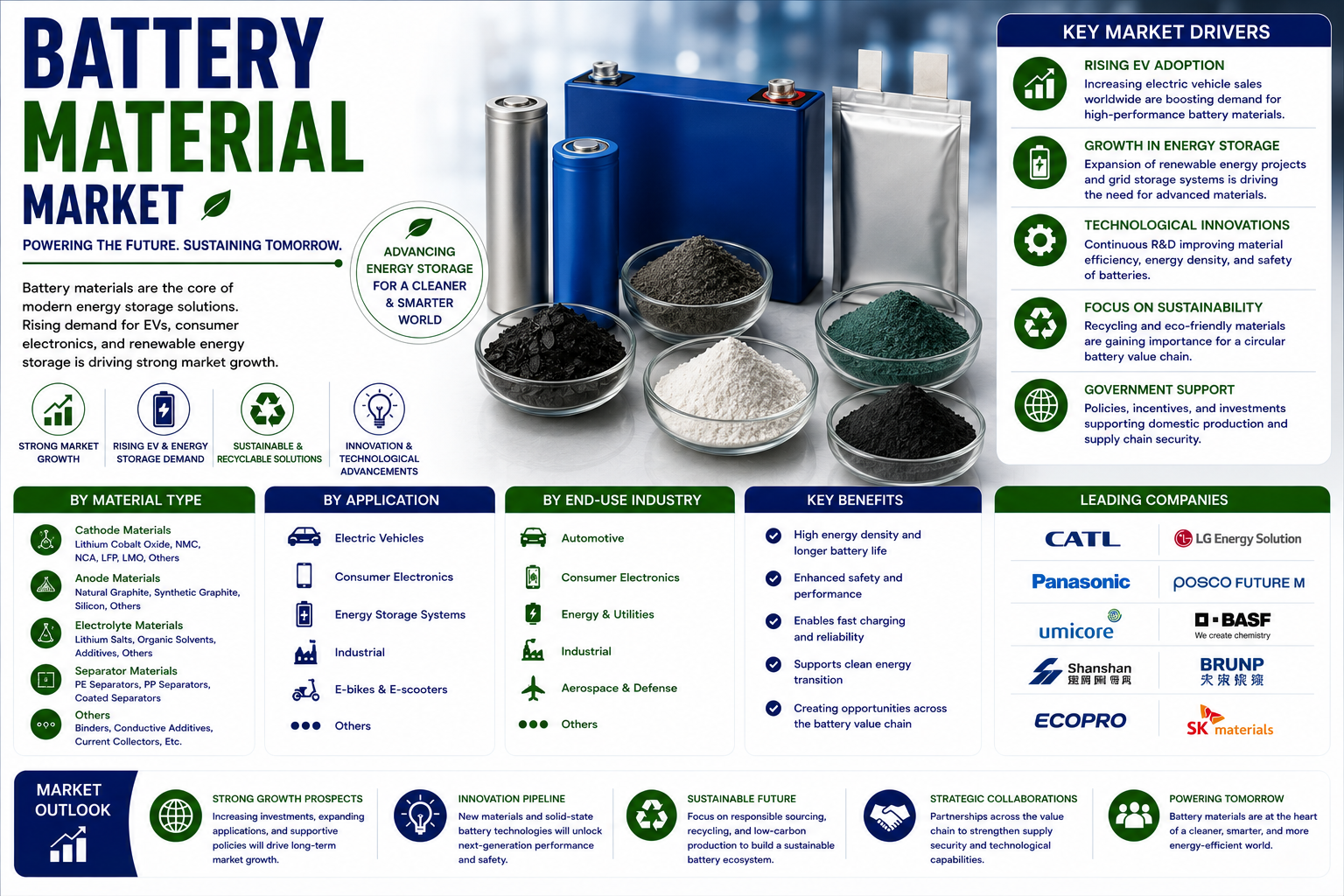
Battery Material Market (2026 - 2035)
North America is projected to reach USD 44.85 Billion by 2035, boosted by IRA tax credits and reshoring programs.
Asia-Pacific leads with 48% of the global Battery Materials Market, anchored by Chinese and South Korean refining capacity.”
OR, UNITED STATES, August 14, 2026 /EINPresswire.com/ -- The global battery materials market is entering a period of transformative expansion. Valued at an estimated $69.10 billion in 2025, the market is projected to grow from $77.12 billion in 2026 to approximately $207.01 billion by 2035, registering a compound annual growth rate of 11.6%. This trajectory is being driven by a convergence of electric vehicle production scale-ups, government localization mandates, and the rapid deployment of grid-scale energy storage systems that are fundamentally rewiring how the world sources, processes, and consumes the critical compounds that power the energy transition.— MRFR
The Policy and Technology Architecture Driving Demand
Three overlapping policy frameworks are actively reshaping the competitive landscape. The U.S. Inflation Reduction Act has channeled over $40 billion in incentives toward domestic battery supply chains through 2032, including production tax credits of $35 per kilowatt-hour for domestically manufactured cells and $10 per kilowatt-hour for modules. The European Union's Critical Raw Materials Act targets 40% domestic processing capacity for strategic minerals by 2030, while the EU Battery Regulation mandates minimum recycled content of 16% for cobalt, 6% for lithium, and 6% for nickel in new batteries by 2031. China's dual-credit policy has already driven new-energy-vehicle penetration past 38% in 2024, creating an insatiable demand pull on upstream materials.
On the technology front, the market is witnessing a structural shift from legacy chemistries toward advanced formulations. Automakers have collectively committed over $600 billion in electrification expenditure through 2030, creating an irreversible demand floor. Battery-pack costs dropped below $110 per kilowatt-hour in 2025, triggering a wave of multi-year offtake agreements between automakers and upstream producers. The transition from nickel-manganese-cobalt 532 formulations to NMC 811 and lithium iron phosphate chemistries is shifting procurement priorities, with high-nickel formulations demanding more nickel sulfate and less cobalt, while LFP growth is pulling lithium carbonate and iron phosphate demand sharply upward.
Segment Analysis: Cathodes Lead, Anodes Accelerate
Cathode materials command the largest share of the battery materials market, accounting for approximately 43% of total revenue in 2025. This dominance reflects the high cost intensity of nickel, cobalt, and lithium compounds, which typically represent 40–50% of total cell cost. The ongoing migration toward high-nickel NMC 811 and lithium manganese iron phosphate chemistries is driving demand for high-purity nickel sulfate and battery-grade lithium hydroxide at specifications demanding purity levels above 99.5% with strict parts-per-million limits on metal impurities.
Anode materials represent the fastest-growing material segment, forecast to expand at a 12.9% CAGR through 2035. This acceleration is driven by silicon-graphite composite adoption, as manufacturers increase silicon content from 5% to over 20% in next-generation blends. This shift requires new binder systems and pre-lithiation techniques that expand the addressable material set beyond conventional natural and synthetic graphite. China's 2024 graphite export licensing requirements disrupted non-Chinese anode supply chains, pushing buyers toward synthetic graphite alternatives and accelerating regional sourcing shifts mandated by U.S. domestic-content rules.
Download Report Sample Copy with TOC: https://www.marketresearchfuture.com/sample_request/1518
Electrolyte materials were valued at approximately $8.65 billion in 2025, serving the lithium hexafluorophosphate salt market and advanced additive formulations that improve cycle life and safety profiles. Separator materials are growing at a 10.3% CAGR, driven by demand for ceramic-coated polyethylene membranes that enhance thermal stability in high-energy-density cells.
Battery Chemistry Landscape: Lithium-Ion Dominates, Alternatives Emerge
Lithium-ion batteries overwhelmingly dominate the market, capturing approximately 62% of total share in 2025. This segment consumes the vast majority of cathode, anode, and electrolyte production globally, propelled by EV adoption curves and grid storage procurement. Within this category, the shift toward high-nickel NMC 811 and LFP chemistries is reshaping procurement priorities across the supply chain.
Lead-acid batteries, while mature, retain a durable foothold with a projected 4.8% CAGR through 2035. This chemistry continues to serve telecommunications backup power and industrial uninterruptible power supply applications where cost-per-cycle economics still favor the legacy technology. Other battery types, including nickel-metal hydride and emerging solid-state platforms, represented a combined value of approximately $6.22 billion in 2025. Solid-state batteries are poised for commercialization post-2028, with Toyota, Samsung SDI, and QuantumScape targeting pilot-line production between 2027 and 2029. Each solid-state design requires novel sulfide or oxide-based solid electrolyte materials not present in conventional lithium-ion supply chains, creating a greenfield opportunity for specialty material suppliers.
Sodium-ion batteries represent an important emerging category. CATL's first-generation sodium-ion cells entered commercial production in 2024, and several Chinese manufacturers have announced gigawatt-hour-scale lines for 2026. These cells eliminate the need for lithium, cobalt, and nickel, relying instead on abundant sodium, iron, and manganese precursors. While sodium-ion primarily targets cost-sensitive segments such as two-wheelers and short-duration stationary storage rather than premium electric vehicles, it expands the total addressable demand for battery materials rather than directly displacing lithium-ion volumes.
Application Analysis: Automotive Anchors, Storage Surges
The automotive sector stands as the largest end-use application, holding approximately 52% of market revenue in 2025. This reflects the industry's accelerating shift from internal-combustion powertrains to full-electric architectures across passenger, commercial, and two-wheeler categories. Global electric vehicle sales surpassed 17 million units in 2024 according to the International Energy Agency, with each battery electric vehicle requiring between 50 and 80 kilograms of processed cathode and anode materials. BloombergNEF projects global EV penetration will exceed 50% of new car sales by 2035, translating into cumulative cathode material demand exceeding 25 million tonnes over the decade.
Renewable energy storage is the fastest-growing application segment, advancing at a 14.6% CAGR. Regulatory mandates for four-hour-duration resources in California, Germany, and Australia are driving utility and commercial-industrial grid-connected deployments. Each gigawatt-hour of deployed storage requires approximately 750 tonnes of lithium carbonate equivalent, directly linking utility procurement cycles to material market growth. The industrial segment is growing at a 12.2% CAGR, serving forklift fleets, material handling equipment, and backup power systems.
Consumer electronics contributed approximately $12.78 billion in 2025, fueled by global smartphone shipments reaching approximately 1.24 billion units. The miniaturization trend toward thinner devices and longer battery life is pushing demand for cobalt-free cathodes and silicon-dominant anodes in small-format applications. Telecommunications applications captured roughly 7% of market share, serving 5G tower backup and rural connectivity infrastructure.
Regional Landscape: Asia-Pacific Dominates, North America and Europe Reshore
Asia-Pacific leads the global battery materials market with approximately 48% of revenue in 2025 and the fastest regional growth rate at a 13.1% CAGR. This dominance reflects China's vertically integrated refining and cell production ecosystem, which processes over 60% of global lithium, 70% of cobalt, and 85% of natural graphite destined for anodes. China alone captures roughly 64% of the regional share, anchored by CATL and BYD ecosystems that span from raw material refining to finished cell production. India is the fastest-growing market within the region at a 15.2% CAGR, with the National Mission on Advanced Chemistry Cell Battery Storage allocating $2.5 billion in production-linked incentives to attract 50 gigawatt-hours of cell manufacturing capacity by 2030. Japan contributed approximately $4.51 billion, focusing on solid-state research and development and Panasonic supply chain partnerships. South Korea holds roughly 14% of the regional share through aggressive material procurement by LG Energy Solution, Samsung SDI, and SK On. The ASEAN bloc is expanding at a 14.7% CAGR, led by Indonesia's nickel smelting expansion and Thailand's emerging assembly hub status.
Buy Now: https://www.marketresearchfuture.com/checkout?currency=one_user-USD&report_id=1518
Europe holds the second-largest global share at approximately 22%, propelled by the EU Battery Regulation and ongoing gigafactory construction in Germany, Sweden, and Hungary. Germany anchors the region with roughly 28% of the European share, driven by automotive original equipment manufacturer demand and BASF's Schwarzheide cathode materials plant. The United Kingdom is growing at an 11.8% CAGR through Britishvolt successor projects and recycling research and development. France is projected to reach $2.94 billion by 2035, anchored by the Dunkirk gigafactory corridor. Italy holds roughly 7% of the regional share through specialty electrolyte production. Spain is expanding at a 12.1% CAGR as lithium mining permits advance in Extremadura. The Nordic countries account for approximately 11% of the regional share, benefiting from Northvolt's supply chain and green energy cost advantages. Europe's overall regional CAGR stands at 12.4%, reflecting the aggressive localization push under the Critical Raw Materials Act.
North America is rapidly expanding and projected to reach $44.85 billion by 2035. The United States dominates with approximately 76% of the regional share, benefiting from Inflation Reduction Act tax incentives and Department of Energy Loan Programs Office commitments exceeding $12 billion for battery material processing facilities. Over 15 announced gigafactory projects across Tennessee, Georgia, and Nevada collectively require an estimated 280,000 tonnes of lithium carbonate equivalent annually by 2030. Canada is growing at a 13.5% CAGR, with mineral-rich provinces including Quebec, Ontario, and Manitoba attracting refining investment from Stellantis, POSCO, and Umicore. Mexico contributed approximately $1.18 billion in 2025, emerging as a nearshore processing hub linked to U.S. automotive original equipment manufacturers.
South America contributed approximately 6% of global market revenue in 2025. Brazil dominates with roughly 38% of the regional share through graphite mining and growing domestic EV assembly. Argentina is the fastest-growing South American market at a 13.9% CAGR, with Jujuy and Salta provinces attracting over $5 billion in announced direct lithium extraction investments from POSCO, Ganfeng, and Allkem. Chile and Bolivia remain significant players, though Chile's new concession framework has added 18 to 24 months to project timelines through mandated impact evaluations on indigenous water rights.
The Middle East and Africa region is expanding at a 9.8% CAGR. Saudi Arabia is growing at an 11.2% pace through Vision 2030 downstream battery value chain investments. The United Arab Emirates contributed approximately $0.31 billion, positioning itself as a regional recycling and refurbishment hub. South Africa accounts for roughly 22% of the regional share through manganese ore supply for cathodes. The Democratic Republic of Congo remains the dominant cobalt supplier globally, while Egypt is expanding at a 10.5% CAGR through phosphate-based LFP feedstock potential.
Competitive Landscape
The battery materials market exhibits low concentration, with a fragmented competitive structure. The top five companies collectively hold an estimated 28 to 34% of global revenue, corresponding to a Herfindahl-Hirschman Index below 500. Competition is stratified by material type, geography, and chemistry, with Chinese refiners leading volume production and Western suppliers competing on quality certification and ESG compliance.
Albemarle Corporation leads with an estimated 5 to 8% revenue share as the largest Western lithium producer, operating lithium hydroxide and carbonate facilities across the United States and Australia. Umicore captures roughly 4 to 7% as a European leader in nickel-manganese-cobalt cathode active materials and closed-loop recycling pioneer. BASF SE holds approximately 4 to 6% through its Schwarzheide plant and integrated chemical supply chain. Ganfeng Lithium accounts for roughly 4 to 7% as China's largest converter, vertically integrated from mines to battery cells and solid-state materials. Sumitomo Metal Mining captures approximately 3 to 5% through high-nickel cathode precursors and long-standing Panasonic and Tesla supply relationships.
Report Summary: https://www.marketresearchfuture.com/reports/battery-material-market-1518
SQM holds roughly 3 to 5% through low-cost Chilean brine operations. POSCO Future M captures approximately 3 to 5% with an integrated Korean supply chain serving LG Energy Solution and Samsung SDI. In November 2023, POSCO broke ground on a $750 million cathode materials plant in Gwangyang with targeted annual output of 100,000 tonnes. Mitsubishi Chemical Group holds roughly 2 to 4% through electrolyte solvents and separator films. Targray Technology International captures approximately 1 to 3% as a specialty distributor with global logistics capabilities. Johnson Matthey accounts for roughly 1 to 3% as it pivots from automotive catalysts to lithium iron phosphate and high-nickel cathode materials. Tianqi Lithium holds approximately 3 to 5% through lithium hydroxide production and Greenbushes mine equity.
Recent strategic developments include Ganfeng Lithium signing a 10-year lithium hydroxide offtake agreement with BMW in June 2024 valued at an estimated $3 billion, securing long-term European auto-sector demand. The European Commission published delegated acts under the EU Battery Regulation in March 2024 specifying carbon footprint calculation methodologies and recycled content thresholds effective from 2027. Umicore entered a joint venture with Volkswagen's PowerCo in August 2023 to supply cathode active materials for Volkswagen's European gigafactory network starting in 2026.
Similar Report
Battery Additives Market https://www.marketresearchfuture.com/reports/battery-additives-market-7521
Battery Separator Market https://www.marketresearchfuture.com/reports/battery-separator-market-7833
battery raw materials market https://www.marketresearchfuture.com/reports/battery-raw-materials-market-24883
lithium ion battery material market https://www.marketresearchfuture.com/reports/lithium-ion-battery-material-market-28571
battery metal market https://www.marketresearchfuture.com/reports/battery-metal-market-23721
Market Research Future
Market Research Future
+ +1 855-661-4441
email us here
Legal Disclaimer:
EIN Presswire provides this news content "as is" without warranty of any kind. We do not accept any responsibility or liability for the accuracy, content, images, videos, licenses, completeness, legality, or reliability of the information contained in this article. If you have any complaints or copyright issues related to this article, kindly contact the author above.
